
Do what thou wilt shall be the whole of the Law.
Ph’nglui mglw’nafh Cthulhu R’lyeh wgah'nagl fhtagn.
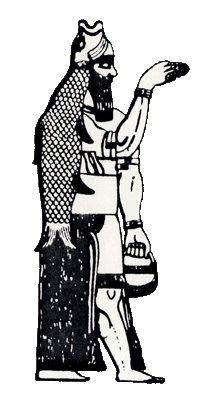 The Esoteric Order of Dagon (E∴O∴D∴)
is a serious occult Order which has been working Lovecraftian magick for over 40 years.
The E∴O∴D∴ utilizes the so-called Cthulhu Mythos of the
horror and fantasy writer H. P. Lovecraft as a magickal method of exploring
the Collective Unconscious. The Order claims descent from the traditions of the
Sirius mystery cults of ancient Egypt and Sumeria.
The Esoteric Order of Dagon (E∴O∴D∴)
is a serious occult Order which has been working Lovecraftian magick for over 40 years.
The E∴O∴D∴ utilizes the so-called Cthulhu Mythos of the
horror and fantasy writer H. P. Lovecraft as a magickal method of exploring
the Collective Unconscious. The Order claims descent from the traditions of the
Sirius mystery cults of ancient Egypt and Sumeria. 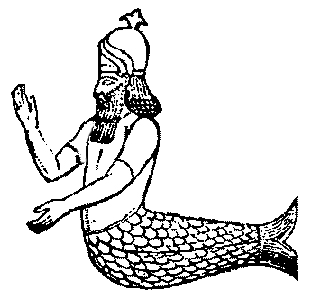
Other influences include Kenneth Grant (23 May 1924 - 15 January 2011), the British occultist, disciple of Aleister Crowley, and head of the Typhonian Order, who also attaches great occult significance to the writings of Lovecraft.
The excellent H.P. Lovecraft Amateur Press Association of the same name has no connection or relationship with us.
Many people have an incomplete or distorted history of our organization, mostly due to the difficulty in getting accurate information about it. Other supposed esoteric groups using the same name are obviously bogus upon careful inspection and can be dismissed as fraudulent and sources of misleading disinformation.
The name of our Order is derived from the story The Shadow Over Innsmouth by the New England horror and fantasy writer H.P. Lovecraft, (1890-1937). Written in November/December, 1931 and published in 1936, it was the only book of HPL’s fiction to be published and distributed in his lifetime.
Lovecraft’s fiction, first published in the American pulp magazines such as Weird Tales, presents an internally consistent cosmology, constructed through the literary realizations of the author’s dreams and intuitive impulses. This cosmology came to be known as the “Cthulhu Mythos”, after its central deity. These stories and novels contain hidden meanings and magickal formulae unknown even to their creator.
Lovecraft suffered from an acute inferiority complex, which prevented him from personally crossing the Abyss in his lifetime. He retained a rational, skeptical view of the universe, despite the glimpses of places and entities beyond the world of mundane reality, which his dream experiences allowed him. He never learned the true origin of the tremendous vistas of cosmic strangeness that haunted his dreams. He never realized that he was himself the High Priest ‘Ech-Pi-El’, the Prophet of the dawning Aeon of Cthulhu.
Before he died, Lovecraft left behind the “Silver Key to the Ultimate Gate” in the form of Randolph Carter, his most developed character who appears in no less than seven works by Lovecraft. This character assumed an independent existence during and after Lovecraft’s life, a created being called a thoughtform, and known in Tibet as a Tulpa. For many years Randolph Carter waited in the parallel world that men and women of this world can sometimes visit in dreams for someone to discover the clues to the Mythos that Lovecraft had unconsciously revealed in his stories.
On the "Necronomicon"
(From http://en.wikipedia.org/wiki/Necronomicon)
The Necronomicon is a fictional grimoire appearing in the stories by horror novelist H. P. Lovecraft and his followers. It was first mentioned in Lovecraft's 1924 short story "The Hound", written in 1922, though its purported author, the "Mad Arab" Abdul Alhazred, had been quoted a year earlier in Lovecraft's "The Nameless City". Among other things, the work contains an account of the Old Ones, their history, and the means for summoning them.
The Astral Necronomicon
Kenneth Grant, the British occultist, disciple of Aleister Crowley, and head of the Typhonian Order suggested in his book The Magical Revival (1972) that there was an unconscious connection between Crowley and Lovecraft. He thought they both drew on the same occult forces; Crowley via his magic and Lovecraft through the dreams which inspired his stories and the Necronomicon. Grant claimed that the Necronomicon existed as an astral book as part of the Akashic records and could be accessed through ritual magic or in dreams.
The existence of mythical books is best illustrated by the short story The Library of Babel by Jorge Luis Borges